Showing posts with label Contemplative. Show all posts

Monday, October 04, 2010

St. Francis, M. Maria Celeste, and the Inspiration for the Congregations of the Redemptorists

        Mother Maria Celeste received the Inspiration for the foundation of the Order of the Most Holy Savior (a name changed later to the Most Holy Redeemer) on 1729 but she had to wait until 1731 to see it come to life on Pentecost Day, May 13 on that year, when the Sisters started living out the new Rule. On August 6 of the same year 1731, the Feast of the Transfiguration they changed the habit of the Visitation they had been wearing for the new red tunic and blue mantle as revealed to M. Maria Celeste for the new Institute.

         That same eventful year of 1731, M. Maria Celeste received the Inspiration for the foundation of the male branch of the same Institute, that is the Congregation of the Most Holy Redeemer better known as the Redemptorists. This happened on the Feast of Saint Francis of Assisi and under his patronage and example as it was recorded by M. Maria Celeste in her Autobiography:
One day, the vigil of the Feast of St. Francis of Assisi, the 3rd of October in the year 1731, this Religious who had received the new Rule being in the refectory, her mind was in one moment lifted up to the Lord. Then Jesus showed Himself to her surrounded by the light of glory, accompanied by the seraphic Father Saint Francis and Father Don Alphonso de Liguori. Then the Lord said the her: "This soul [Alphonsus Liguori] is chosen as the head of My Institute. It is he who will be the first superior of the Congregation of men."


The Religious [M.M. Celeste] saw in God this work as if it were already established, and her soul was so filled with joy that she could not take any food. She saw herself surrounded with an interior light, and remained close to the holy Patriarch [St. Francis], who seemed to be transformed into Our Lord Jesus Christ. This lasted all the time of the meal.


       It is worth noticing that M. Maria Celeste pointed out that in her vision Saint Francis "seemed transformed into Our Lord Jesus Christ", which is the specific Grace or charism of the new Institute of the Most Holy Savior/Redeemer she was being called to bring to life. This transformation of herself into Christ was a frequent happening that she repeatedly recorded in her writings, and happened on many occasions but always after receiving Holy Communion, the Sacrament of our Transformation into Jesus Christ.

       But let us continue listening to M. M. Celeste and her connection with St. Francis on his Feast Day involving also (the then future St.) Alphonsus Liguori:
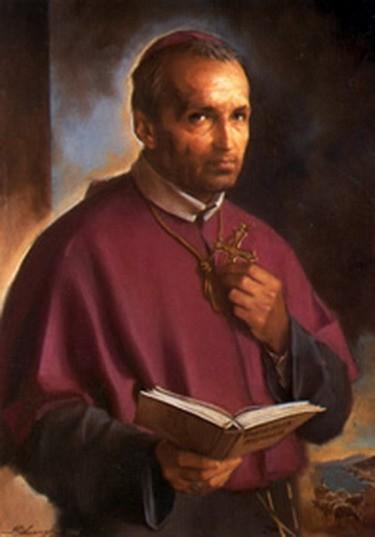
For the moment nothing else was revealed to her, and so this Religious made no accoumt of it, and told no one anything about it.
The next day, the Feast of the holy Patriarch to whom she had a great devotion, she went to Communion much absorbed concerning what had happened to her overnight. Suddenly her soul was illumined by a light of the Lord and she understood that she was to write as the motto of the Institute these words of the Gospel, 
Go and preach to all creatures that the Kingdom of Heaven is at hand. 
(cfr. Mc 10.16 & Mt 10,7)
Based on these words she should write out the text that the Lord dictated to her in His Name:
The daily and spiritual exercises were the same as those already written in the new Rule [for the Nuns]. Also the habit was to be like that prescribed. 
All the Religious were to live in apostolic poverty like His well-beloved servant whose feast they were keeping that day -who had so closely imitated Him. For this reason, all their worldly goods were to be placed at the feet of the Superior, who would make a common fund of them, called that of the poor, which they would use on missions, and would give alms from it to widows and orphans according to the directions of the Superior.

      It is clear how significant "apostolic poverty" is to the new Institute, both of men -the Missionaries, Brothers and Priests- and women -the Redemptoristine Nuns. This is no surprise given that the Institute is to be rooted in the admirable humiliations of the Word Made Man, with charity and humility as the capstone. A deep spiritual poverty is called forth as well as the visible Franciscan poverty.

      M. Maria Celeste continues explaining this first Inspiration of the Congregation of the Redemptorists:

In their journeys they will go two and two to places not too distant from their dwellings, and they will preach penance.


      And here comes from M M. Celeste's pen something especially close to the heart of this Redemptoristine Diocesan Hermit attesting to how much the call to transforming prayer in solitude is at the heart of our charism for both the Redemptorists and the Redemptoristines:

As to those who are called to the contemplative or eremitical life, they are not to be reproached, for those souls who apply themselves to prayer in solitude convert many more souls than those who are destined to preach.


They will be at least thirteen in each house and they are not to go on mission by their own choice, but by the will and choice of the Superior.


This was the first sketch concerning the Congregation of men that this Religious received from the Lord. She wrote down all that had been said to her and added it to the Rule of the nuns, as it was to form only one with theirs, as will be written in the proper time.
This Religious made a detailed statement to her spiritual father [Don Tomaso Falcoia] of all that had been communicated to her about the new Congregation of men, and of all the other things that had been revealed to her. 


      May the holy Patriarch Saint Francis show his patronage over M. M. Celeste's Double Institute of Women and Men dedicated to bringing the Good News to the poor through the combination of their personal contemplative transformation into Christ as well as through the preaching of the Gospel message to every creature. 


      Saint Francis of Assisi, Pray for us!

Thursday, May 27, 2010

The Freedom of the Children of God

With the solemn feast of Pentecost we come to the end of the Easter season which we have been celebrating for 50 days commemorating the Resurrection of Christ. On Monday after Pentecost we have again Old Testament texts at the Office of Readings starting with the beginning of the Book of Job.
The story is familiar, a fictional conversation between God and Satan which turns Job's life upside down and inside out. In one day the rich man looses all his possessions, his herds, his sons and daughters, his servants ... As Job receives one piece of news after another he is broken down in distress and has only one thing to say:

"Naked I came forth from my mother's womb,
and naked shall I go back again.
The Lord gave and the Lord has taken away;
blessed be the name of the Lord!" Job 1:21

It strikes me the freedom of such statement, the total, complete TRUST of accepting the worst of the worst with peace.
Job was a very wealthy man owning all the riches that a successful man could gather, and enjoyed feasting with his large family. But the riches and the celebrations didn't take in his heart the place of the Absolute. What an incredible freedom!

This deep sense of Job's freedom has remained with me for several days with almost a feeling of envy. At this point of the story Job is not yet in rags, he is the master of many servants, the respected elder, the faithful worshiper of the Almighty. But above all he is used to looking at the Real in the eyes and can surrender from the bottom of his being. This is the freedom of having all without any attachment. This, I think, is a true "blessed" poor in spirit - and a contemplative.

This reminds me of the freedom of Mary, the Mother of Jesus, at the Annunciation, when in an instant, she risked everything in response to the unexpected, to the "intrusion" of Mystery in her life. With her humble Yes she risked being stoned to death. 

Thomas Merton says somewhere that a contemplative is the person with whom God can do whatever God desires. This is the person totally available to God and to God's Plan. 

We live in times where as a society we are trying hard to grow into human maturity and freedom for everyone, we are trying hard to decide what is best and often the louder voices telling us the direction of our blessings and fulfillment are themselves totally out of touch with their own deepest soul values.

It is good and necessary to work for our betterment and development of our skills, that's the purpose of our gifts and abilities! The paradox of it is that we need to reach that place of maturity and independence where we are liberated from abuse, poverty, ignorance etc., and yet this is only half of the journey. Even if/when we get there a whole new and intense journey has still to take place. This is the journey of transformation, the divinization of the Christian spiritual journey. It is an ascension into minority. It is about growing smaller and true, real. It is about discovering our utter dependence on God once we have reached all the goals of human development. When we have all that can be achieved, when we have lived and been productive and successful we can discover that it is not enough and that more of the same will never be enough.

This is the time to respond to life with heart and soul, with the faith of an infant who is carried in her mother's arms, small and free to welcome life as it really is coming from the Womb of our Destiny, even if that destiny brings -as it does for all of us- aging, sickness, and diminishment.
We have a Christian name for this, we call it the Paschal Mystery, a mystery of suffering, death, and burial which culminates in an unforeseen fullness of Life. In God. 

Sunday, May 16, 2010

Ascension of the Lord


After the ordeal of the Passion and death of Jesus, the disciples experienced the incredible shock of a fullness of life they could touch, see, talk to and with. This was called the Resurrection, that is, the same Jesus alive and living yet not the same but rather evasive and transcendent.

The Ascension is a further step into the Mystery. Now Jesus is no longer seen or touched but the learning of the Easter days remains: Jesus, the Christ, is alive and present, near, intimate, he is The Lord.

This new step is somehow familiar territory to the apophatic contemplative who remains like Mary (the Mother of Jesus) and with her praying in the upper room, holding in faith the emptiness of the senses and the ignorance -maybe the overwhelming void- of the mind.

Mary of Nazareth, Mary Mother of Jesus, holds the womb in which new life is being gestated, in which the transition will be possible to a newly born interpretation, understanding, and evidence of God's action and presence.

The Church will be born in Pentecost from the contemplative womb of faith.

The Contemplative Church enters again today in the Cenacle of prayer for a new birth of the Church in this time of history. Let us be the contemplative Church gathered in prayer, together with Mary, the Mother of Jesus.